
On Pornography | Boston Boudoir Photographer
What color is orange?
It seems like a silly question to ask because any elementary schooler could tell you that it’s a mix of red and yellow. But look closer at that spectrum: at what point does it stop being red and start being orange? At what point does orange surrender to yellow? For some shades it’s going to be simple, but eventually you’ll hit a point where you could go either way.
We think of color as a basic concept, but its reality is deeply complex. Our perception of color, our feelings about color, are shaped by our bodies, our cultures, our experiences, and even its context[1].
So what does orange have to do with pornography?
Famously, Supreme Court Justice Potter Stewart once wrote about hardcore pornography that “I know it when I see it[2].” In the 60 years since that case was decided, courts have repeatedly proven that it’s not so simple to define what is and isn’t obscene. They recognized that the line for what makes something art or pornography was constructed by culture and commerce. They’ve acknowledged that the line separating art from pornography is not fixed but is instead shaped by culture and commerce. As there’s a spectrum between red and yellow, there’s a spectrum between Gustave Klimt’s "The Girlfriends" and the output of Girlfriends Films[3]. Where does the line fall, and why does it matter?
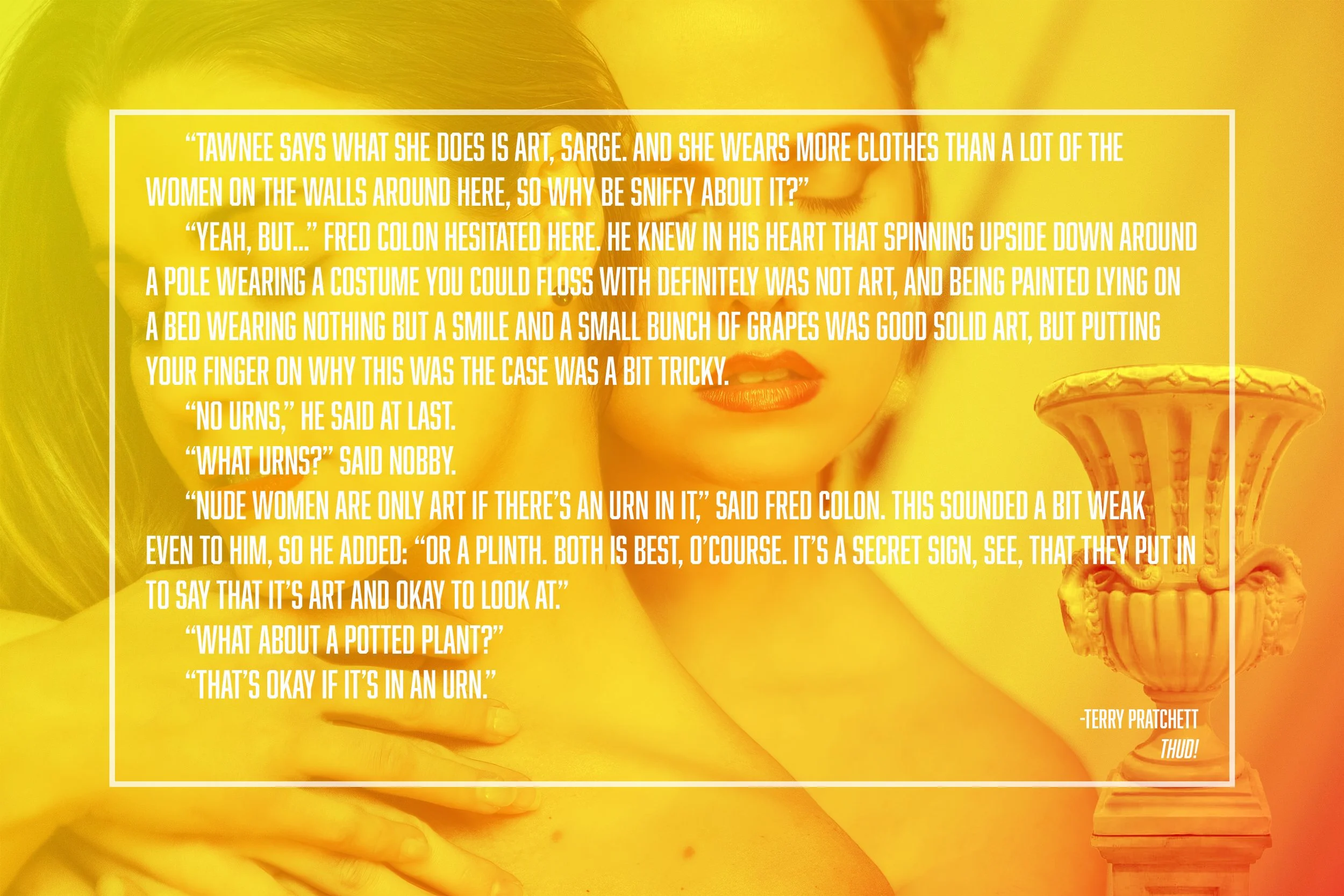
Photo Illustration - Models @lumenfoxx and @krystalkitten828 on Instagram, urn via Creative Commons.
We stand at an inflection point between culture and commerce that threatens to expand what is obscene far beyond what might get called “pornographic” at a glance. Platforms like Youtube, Instagram, and TikTok heavily censor sensitive topics through demonetization, algorithmic suppression, and outright deleting content that violates their often arbitrary and capricious guidelines. This creates a sanitized environment that’s safe for advertisers, but means there’s no public square where creators can address important and challenging topics. This stifles discussions about sexuality, identity, and our bodies. The lack of transparency also makes it difficult for artists to operate in such a vital space. And sometimes you just want to look at hot people doing hot things - sexuality and eroticism are important dimensions in our lives.
At the same time, conservative groups are mounting direct attacks on LGBTQ+ representation, drag performances, queer literature, and educational materials by labeling them as pornography. This deliberate expansion of the term “pornography” fuels massive government intrusions into private life, criminalizing and surveilling consensual adult behavior—particularly in marginalized communities.
These combined forces—corporate censorship and legislative overreach—threaten to erode personal freedoms and destroy our ability to engage with diverse perspectives, complex ideas, and nuanced emotions. Labeling art as “pornographic” and then criminalizing it (as I wrote this Oklahoma is considering a bill to jail porn creators) stifles creativity and societal empathy. This is not about protecting the public but about consolidating control.
Protecting all art, even art you might not personally enjoy, matters. Expressing yourself through art, in all its forms, is an act of liberation—even if the liberation is just from some of your bills. Engaging with art, whether critically or emotionally, can expand your understanding of yourself and your world. Pleasure, for its own sake, is essential for human flourishing. In a world that seeks to drain your humanity, eroticism can be a radical act.
What can we do to push back against this creeping censorship? Support artists and creators that are making things that resonate with you - even if it’s just amplifying their work (though obviously buying things helps out a lot). Donate to advocacy groups that are getting organized to protect their communities and our rights. Demand transparency and accountability from platforms moderating content and politicians pushing a puritanical agenda. Above all don’t let these bastards get you down.
Footnotes and Further Reading:
[1] “Why Can’t We Agree on Color” (https://www.datacolor.com/learn/data-of-color)
[2] “Jacobellis v. Ohio” (https://en.wikipedia.org/wiki/Jacobellis_v._Ohio)
[3] These examples are mostly for the symmetry of girlfriends to girlfriends not a particular value judgment
[4] Free Speech Coalition (https://www.freespeechcoalition.com/blog/how-project-2025-threatens-the-rights-of-sex-workers-and-the-lgbtq-community)
[5] Electronic Frontier Foundation (https://www.eff.org/deeplinks/2025/01/impact-age-verification-measures-goes-beyond-porn-sites)
[6] https://www.xbiz.com/news/286792/oklahoma-state-senator-introduces-bill-to-criminalize-all-porn-jail-creators